Six Disruptive Trends in Architectural Lighting ---B---
Welcome to the luminous ‘20s < 二 >
(continued)
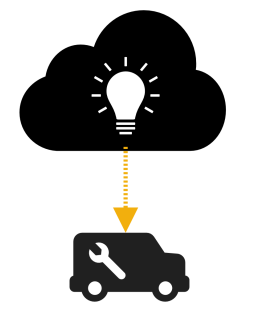
Smart Maintenance Programs
IP-connected lighting systems greatly expand the range of data available. “Smart” controls and lighting fixtures broadcast their component serial numbers, feature sets, on-board sensors, run time counters, and even real-time photometric light measurement. Talk about “big data”: A lighting manufacturer can now remotely check in on their systems anytime, anywhere.
For example, a manufacturer might automatically see that a fixture is over temp and losing light output in one of their customer’s facilities, and they will automatically query the exact set of parts that need to be replaced. Such data drastically reduces the cost of lighting maintenance. A service agent will show up with the right parts and immediately take care of the problem – potentially before an end user even recognizes that there is a problem.
Providing a cloud-connection for lighting systems is a “gateway drug” to opening up numerous opportunities for maintenance, upgrades, or circular economy opportunities. The lighting industry has the opportunity to offer much high levels of customer service at lower costs than ever before…but who in the industry captures this value?

Bio-Friendly Materials
LED systems pushing 200 lm/w efficacy effectively eliminate the problem of excess heat and fire hazard in most fixture types. DC power can also simplify fixture design: If the fixture has only low-power, low-voltage, current-controlled connections, the safety requirements stemming around high voltage and high power can be reduced to the SELV standard. The new world of low power and non-existent thermal issues opens up opportunities for the radical redesign of traditional fixture paradigms and material selections. Manufacturers will use innovative bio-based materials to dramatically reduce the embodied energy, reduce toxicity and reduce both production and EOL disassembly costs to create a fixture that is ready for the circular economy.
These are straight forward product design concepts to implement for a wide range of common fixture styles. The hiccup going into the next decade? Lighting safety standards were developed when light sources were hot, dangerous, fragile and driven by high-power AC electricity. If none of those apply anymore, the safety standards need gross revision. For too long safety standards have simply traded immediate liability of fire risk for long term cancer risk via a variety of toxic flame-retardant materials.

Disposable Lamps & Fixtures
On the other side of the coin from durable, maintainable fixtures, there are many lighting applications where basic LED technology outlives the application life (such as consumer lighting, fashion retail, restaurants, etc.). So why are we designing all lighting products to the same standards, using the same expensive materials? We will see a growing trend for designing biodegradable fixtures that minimize their material use and simply compost into dirt at end of life. Imagine a classic A-lamp: The LED and driver are miniaturized into an assembly the size of a vitamin pill and the rest of the bulb could be readily built out of biodegradable materials. And it is conceivable that even the light engine might simply biodegrade, too, with electronic circuits that simply dissolve into healthy minerals and maybe even organic-based LED compounds.

Beautiful Factories
What is more sustainable: Aluminum or wood? An argument can be made for either: Aluminum, once produced, can be recycled endlessly without degradation. Wood loses value each time it is processed. Yet the question becomes far more personal when phrased as such: Would you and your family be willing to live next to any part of the supply chain? Would you live next to an open-pit mine with its toxic tailing ponds or a forest? A smelting plant with its belching smokestacks or a sawmill? An anodization plant with all its toxic chemicals or a woodshop?
So why do lighting designers keep specifying such toxic, energy intensive materials in their products? Why are they accepting products that have no hope of even basic maintenance, much more reusability in the future?

Impact on Design
Designers specify the future. But WHICH future are you currently specifying? Are you proud of the supply chains that support your product selections? The lighting industry needs to take responsibility for the future it is sowing today.
And designers need to think holistically about their projects. Does it do any good to have amazing bio-friendly light fixtures that are drawing their power downwind of a coal-based powerplant? Project teams must take full responsibility for the inputs and outputs of their individual buildings.

6: DC Power & Net-Zero Energy
Buildings will increasingly go off-grid
Do you know why you must lug around all those chargers for your smartphones, tablets and laptops? Why every “smart” device in your home or office requires some big, obnoxious power brick? Why the solar panels on your roof require some giant inverter box in your garage?
It’s because every digital device in our modern world runs on DC (direct-current) electricity, while our ancient electric utility grids and the wiring infrastructure in our buildings remain stuck using AC (alternating-current). Every time you plug a power converter into those ancient AC-grids, you are wasting electricity. Ever notice how hot those power converters get? That is your electricity, money and planet being squandered as waste heat.
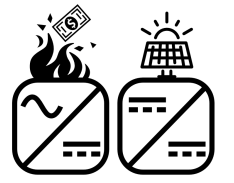
Commercial Buildings are all DC
Almost every device in a modern building or home uses DC, including LED lighting, sensors, computers, IT networking and even large motors (variable-speed heat pumps and air conditioners). Literally thousands of devices in even modest sized commercial or multi-unit residential buildings require these wasteful power converters. And to compound this huge disconnect between our AC electrical grids and our DC building infrastructures, we are now adding huge quantities of DC-generating solar panels and DC-based battery storage to make our buildings net-zero energy consumers. The cost of onsite solar PV generation has dropped to the point of grid parity – or cheaper – meaning that in many cases it is cheaper for a building owner to generate their own DC power rather than to buy AC power from a utility company. And the cost of onsite battery storage continues to drop, bridging the gap between the peaks and troughs of generation and consumption.
Here is the shocking number: Researchers estimate that commercial buildings save 15% of their total power by skipping wasteful DC-AC-DC conversions. Why is 15% such a big deal? Because it is estimated that commercial and residential buildings consume 40% of the total energy used in the United States.
Batteries Sold Separately
Modern buildings going forward will only need extra power from the grid for small durations of the year, such as during the coldest, darkest part of the winter in Northern climates. The rest of the year, buildings will run almost entirely on internal flows of DC power. We are at the inflection point of a new revolution: DC-power “nanogrids” are set to replace the AC-infrastructure in many, if not most, commercial buildings, resulting in massive energy savings while reducing hardware and providing advanced digital control of power.
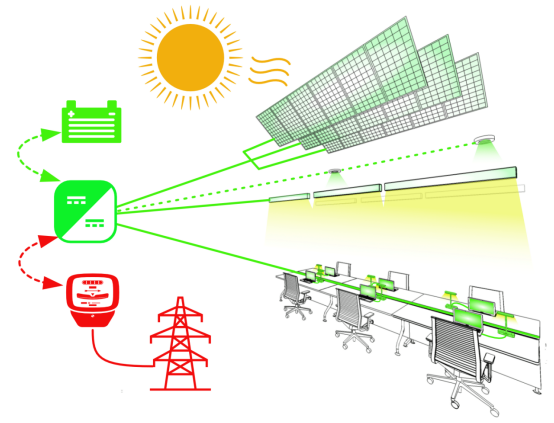
Early pilot projects show tremendous promise for the DC power revolution. To throw fuel on the fire, the USGBC just added substantial bonus points for including DC power systems in its LEED green building certification program.
With DC power, we can reduce power waste substantially, reduce electronic hardware and associated maintenance & e-waste issues, and open the door to advanced energy management in buildings. Advanced DC-based technologies like solid-state switching and solid-state fault interruption promise to channel, manage and measure power with more precision than ever before.

Impact on Design
As we move towards greater numbers of net-zero energy buildings and demand more localized energy resiliency in ever more turbulent times, a most interesting revolution is poised to transform our electrical infrastructure. DC power systems will increasingly reduce the costs associated of evermore advanced architectural systems. From the earliest stages of conceiving a building, solar power must be fundamentally included with as much capacity as possible. Digital twin simulations in the energy performance of a building, starting at even the earliest schematic design stages, will predict long term energy performance of those systems and directly lead to highly tailored electrical infrastructures.
Conclusion: The Year 2030
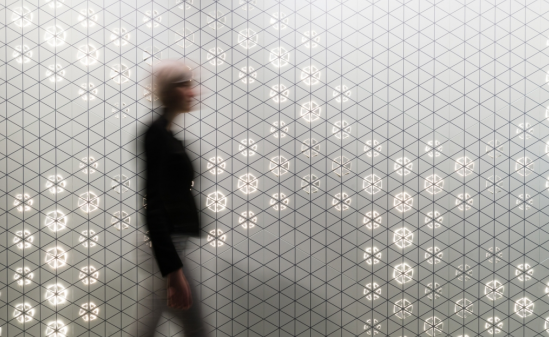
By the year 2030, what we call “architectural lighting” will increasingly consist of embedded luminous surfaces, rich with digital content, smartly driven by data streams and responsive to our physical actions and biological needs in a space. Designers (architects, interior designers, lighting designers, etc.) will increasingly need to become experience designers, using scripting, storyboarding and digital-twin simulations to craft live, responsive new experiential concepts for guests, shoppers, patients, employees, and so forth.
Despite growing system complexity, project coordination and on-site installation costs will be reduced via digital-twin, cloud-connected commissioning and sophisticated integration of BIM processes. And these projects will use DC-power systems to reduce the consumption and cost of all these digital systems while making our buildings net-zero energy consumers. The physical hardware of lighting systems will be designed to maximize new revenue streams opened by circular economy strategies, while simultaneously reducing our environmental impact.
The Roaring ‘20s indeed look to be a brilliant decade for innovation in architectural lighting systems.
---Ending---
Recommend
-

-

QQ Zone
-

Sina Weibo
-

Renren.com
-

Douban