Sign in
 Join in
|
Six Disruptive Trends in Architectural Lighting ---A---Welcome to the luminous ‘20s < 一 > The past decade saw incredible transformation in architectural lighting. LEDs and digital controls completely disrupted decades-old technology paradigms. Yet the transformation to LED technology was so drastic, most manufacturers could barely keep up. Playing it safe, the lighting industry spent the past decade merely “LEDifying” tired old commodity fixture styles. In the end, ironically, the LED revolution led to little actual application-level innovation on commercial projects. Facing the turn of a new decade, another disruptive wave of innovation awaits, but this time building upon mature LED and digital communications technologies. Let’s look at how 6 disruptive trends will change how we conceive of architectural lighting:
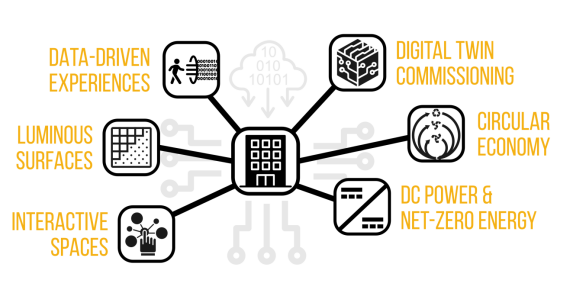
1: Luminous Surfaces Embedded lighting and digital signage become fundamental elements of contemporary buildings LED technology now allows us to integrate lighting directly into a wall or ceiling surface, with little energy consumption, heat, or maintenance to worry about. This fusion of light + material, of embedding lighting elements directly into architectural surfaces, opens fresh new approaches to creating eye-catching spatial experiences.
Play of Brilliants Architects and interior designers have long tried to break free from the constraints of traditional light fixtures, to use light as a form of fundamental building material to add visual richness to architectural surfaces. Fusing the best properties of luminosity, optical effects, material richness and graphic design, embedded lighting opens tremendous creative opportunities. Luminous surfaces will change the way people perceive, occupy and enjoy architectural spaces, particularly in hospitality, retail, and public applications.
Embedded Lighting Systems Custom integration of embedded lighting has been difficult to specify and costly to install on construction projects, limiting broader adoption. While designers explore the creative possibilities of embedded patterns and surfaces of light, manufacturers need to develop flexible and customized product systems that accommodate an enormous range of creative styles, along with digital technologies to speed the design, visualization and fabrication processes.
Animation Digital controls add the element of time and animation to architectural surfaces. People are mesmerized by the beauty of light in motion; we are hard-wired in our brains to seek visual stimulation to refresh ourselves. As architecture becomes fully digitally controllable, with every point of light addressable as a sort of pixel, custom tailored dynamic animations ranging from the subtle flicker of a candle to sparkling effects to vivid ripples of movement will become common.
Digital Signage Beyond using luminous surfaces for general illumination, digital signage systems will be included in architectural spaces with tighter integration of design concept. Digital signage is already becoming pervasive in architectural environments with widespread adoption in out-of-home marketing, wayfinding, menu systems, and retail branding. The steadily dropping cost of digital screens and cloud-based content distribution makes digital signage highly appealing to brands and organizations looking to quickly inject more “digital” into their physical locations.
Flashy-Flashy However, there is a big problem with digital signage: People quickly burn-out on flashy-flashy-winky-blinky screens. Even though digital signage is just starting to be widely integrated into our built environments, people are already overloaded and desensitized to evermore screen time. The content becomes irrelevant: No matter how gorgeous the imagery, how elaborate the video editing, how slick the motion graphics – it all just becomes visual “noise” that people tune out. Across the next decade, design professionals need to become savvy on integrating both luminous surfaces and digital signage into comprehensive environmental experiences. Architectural- or even urban-scale compositions can be created using digital lighting/pixels/screens of various proportions, scales and resolution with mixed visual acuity. Designers will develop sophisticated strategies to break the scale and proportions commonly associated with “screens” and to layer luminous surfaces to create rich spatial and visually healthy experiences.
Content is King Architectural lighting designers must become motion artists. No longer can architectural lighting be considered the magnificent play of volumes brought together in light when the volumes themselves now emit light…and so much more. When every point of light in a building is effectively a digital pixel, designers need to create continuous fluid visual experiences. The concept of editing “timelines” at different scales becomes a critical skill, ranging from short term personal experiences, to daily cyclic patterns, to seasonal cyclic patterns.
Healthy Interior Lighting Whatever you call it – circadian lighting, human-centered lighting, melanopic response – the implementation of “healthy” interior lighting will be largely implemented through luminous surfaces. Why? Because the old fixture paradigms from the 1960’s are ill equipped to provide not only the scientific quantities of the right light at the right time, but they are woefully unable to create great psychological experiences for inhabitants spending long hours in enclosed spaces. The layering of luminosity, at far greater contrast levels than designers are accustomed to in interior environments, plus the inclusion of highly dynamic scene changes tailored for maximum biological and psychological response, will be critical concepts that architects, interior designers and lighting designers will need to embrace and explore throughout all the other aspects of their designs.
Impact on Design The inclusion of luminous surfaces begs for comprehensive design to create a unified experience for the occupants of a space. This will drive architects, interior and lighting designers to embrace a raft of new digital tools, such as using live-rendered photo-realistic game engines, VR experiences, video editing, motion graphics, etc. throughout their design development process. Designers will need to visualize, simulate and craft not only simple luminous surfaces, but dynamic surfaces that interconnect the digital world with the occupants of the space.
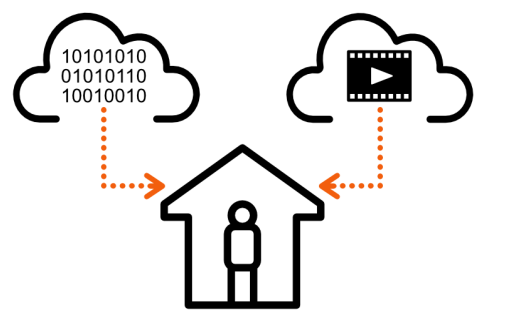
2: Data-Driven Experiences Architecture will increasingly be treated as a portal to the virtual world We are entering a future where architectural design and its associated technology systems are more than ever focused on experience management as the primary end goal of many projects. Architectural technology systems, such as digital lighting, digital media, and IoT-based communications systems are driving this digital transformation of physical space. No longer can traditional architectural technology systems remain as discrete, specialty trades. This is especially true for architectural lighting, where outdated preset scene control systems must transform into comprehensive experience management systems. What we presently call lighting controls will be subsumed into two primary styles of technical solutions:
1. Media-Driven Branded Experiences 2. Data-Driven Environmental Optimization Such a transformation will have profound influences on how bricks and mortar spaces are conceived and designed by architects, interior designers, brand designers, etc.
The Old World For decades, traditional preset-scene lighting control systems have dominated the options available for architectural projects. Dimmers or relay switches controlling “dumb” lamps were set at certain levels and recorded as stagnant scenes. End users were left with clusters of anonymous little buttons programmed with scenes that never seem to do what anybody actual wants. It should be readily apparent how unprepared such systems are for the digital transformation of architectural experiences. The New World The role of the built environment is changing in two dramatic ways that render the crudeness of preset-scene systems incapable of responding: Media-driven and data-driven experiences.
1: Media-Driven Branded Experiences The intention of many built environments (e.g., retail, hospitality, corporate lobbies, etc.) is first and foremost to create a branded experience. And it is impossible in our modern age to conceive of branded experiences without a strong digital presence in content and interactivity. Architectural spaces are becoming portals to the virtual world. The technical challenge in these spaces is to control a range of digital media – “pixels” of various sorts, from 4K screens to projection mapping to simple digitally-controlled light fixtures. While traditional architectural lighting controls are wholly unsuited for distributing, playing and managing modern digital media, the digital signage world has filled the gap with cloud-connected, low-cost systems expressly for distributing and playing media files on an range of equipment. For example, a modern 4K digital media player, priced for only a few hundred dollars, has effectively 24 million channels of lighting control (3 channels for every RGB pixel in a 4K screen) – and that is just one single screen location, with these systems capable of handling hundreds.
2: Data-Driven Environmental Optimization For environments that are not primarily branded experiences (e.g., commercial offices, institutional facilities, industrial sites, etc.), environmental optimization based on live data becomes the imperative. And stagnant, pre-configured scenes are simply not precise enough to satisfy modern demands for climate control, energy efficiency, and creating functionally efficient spaces for the occupants. We now have networks of IoT-connected sensors generating massive live-data streams. Plus, numerous other live data streams such as weather, operational conditions, stock market fluctuations, social media engagement, etc. can provide live input to our environments. We need systems that take these live data streams and logically translate them across a range of environmental parameters. Such translation must be smooth, continuous, and employ learning loops (e.g. “A.I.”) to ensure that as a building ages, the live systems remain optimized.
Impact on Design Spaces need to be conceived from the very initial sketches as live, responsive environments, not lumps of steel, concrete and glass bathed in some stagnant conception of light. Architects and interior designers need to understand the powerful potential of these new systems for branded experience control or optimized environmental control and start conceiving of new programmatic goals that fully exploit their potential. And once data-driven lighting becomes the norm, designers can then look more closely at the personal scale of interactions within a space.
3: Interactive Spaces The right light, at the right time, at the right place The concept of interactive lighting – where dynamic lighting or A/V gear responds to a user’s touch, proximity or other activity – has held the promise of creating highly personal and dynamic architectural experiences for several decades, but adoption has been mostly limited to singular art installations.
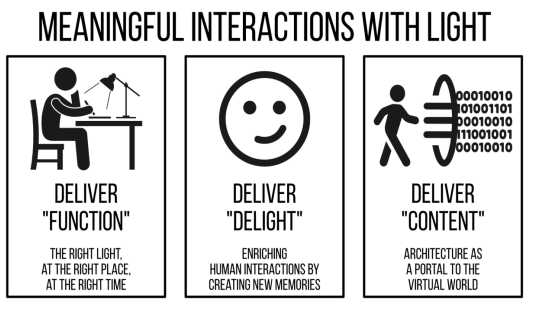
Me and My Shadow One of the biggest challenges with interactive lighting is overcoming the most simplistic yet common interactive setup that we can call the me and my shadow scenario: Many interactive installations do nothing more than mirror someone’s presence, expressed such as through live shadow outlines of the person’s form, or glowing light blobs, or more decorative effects like sparkles or waves that track along with someone. Whatever style, it is still fundamentally the same thing, a 1-to-1 reflection of your presence. But how does this create any more meaningful impact than staring at your own shadow on a sunny day? The effect doesn’t do anything to re-inform or alter the person’s activities in the space. After the first razzle-dazzle experience, it is easily ignored. So Why Implement Interactive Lighting? What modalities of interaction will actually enrich an architectural space? There are at least three possibilities:
Deliver function: The correct type of light, at the correct place, at the correct moment in time. Deliver delight: Enriching human interactions and creating distinct, memorable moments Deliver content: Architecture can act as a portal to the digital world, providing either ambient or detailed layers of information These 3 interactions can then be mapped across applications, such as hospitality, retail, office, healthcare, education, public spaces, etc. Within each application, multiple physical interactions can be explored to deliver the 3 primary modalities, including:
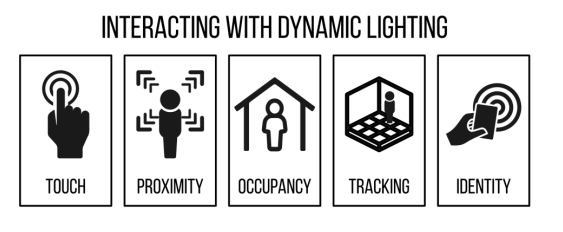
Touch (poking, grabbing, twisting, touching, etc.) Occupancy (passive detection of movement in a space) Proximity (distance from an object/sensor point) Tracking (tracking multiple people in a space, gaze detection, gesturing) Identity (Bluetooth beacons, RFID chips, NFC)
Impact on Design Designers must move beyond document-based design and specification workflows. Architectural designers will increasingly adopt the tools, techniques and language of UX design professionals. In the early stages of concept design, storyboarding must be routinely included to sketch out key dynamic scenarios in spaces. Designers will innovate their own tools, such as using low-cost computing ecosystems like Arduino and Raspberry Pi to create mockups and live models of interactive spaces. As interactive concepts become more commonplace and grow to large-scale installations, live-rendered, fully functional virtual models integrated into BIM workflows will be required to visualize, simulate and develop the functionality of the final space programming.
4: Digital Twin Commissioning Live simulations in BIM will reduce onsite commissioning costs Yah right! So we’re adding highly customized luminous digital surfaces, controlled via complex live data and media streams and tuned to a space via sophisticated interactive control systems. This will all just be “value-engineered” straight off the project, right? The commissioning costs alone are inconceivable. Wrong. Project teams can’t keep sandbagging digital systems in architectural construction projects as outlandish non-essential budget line-items. Digital technologies in the built environment drive very real end customer value. Yet for sure, construction sites are the absolute most expensive place imaginable to attempt flaky digital R&D projects with unknown risk factors, exotic consultants and expensive systems integrators. So how do we overcome this mess? To satisfy clients’ endless appetites for integrating digital sophistication into construction projects, project teams must focus on using simulation and cloud-based commissioning tools which will greatly reduce the costs associated with commissioning lighting or media systems.
Digital Twin Simulation Cloud-based lighting systems will increasingly integrate directly into architects’ BIM-based design, simulation and specification workflow. Architectural design and MEP workflows already use highly detailed BIM models that live in the cloud. Connected lighting systems are fundamentally connected to the “cloud”. Lighting companies focusing on system integration should develop BIM plug-ins that allow specifiers to setup proper BIM-based virtual models of the total lighting system (fixtures + controls + functionality), eliminating the need to translate the “design intent” of the lighting control system via traditional paper documentation and field commissioning. Plus the virtual simulations made easy by BIM will also evolve and directly correlate to the actual performance of the building, which will prove critical for meeting ever more stringent “green” building codes.
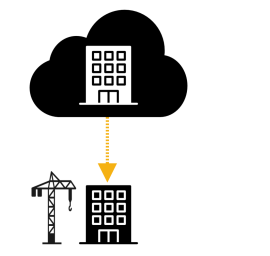
Digital Twin Commissioning If your digital twin BIM-model lives in the cloud and your whole lighting system is cloud-connected, simply connect the lighting system to the cloud and voilà – the virtual model can instantly control the real lighting hardware. Final programming will be transferred via the BIM/cloud model directly to the hardware onsite, reducing on-site commissioning and if done correctly, ensuring the designer’s vision is not broken during construction setup. Skipping the majority of the translation process leads to enormous cost savings on construction sites. The lighting controls segment of the industry desperately needs to move beyond “document based” specification, procurement and site-coordination.
Impact on Design Implicit in this future is the fact that the process of commissioning largely transfers from systems integrators to design consultants. Overall, the process is more efficient, but this still represents a large transfer of project budgets from the construction team to the design team. Designers need to properly understand this new revenue opportunity and find ways to convince clients of the value. Furthermore, the completeness and accuracy of digital-twin model becomes a valuable asset in itself that can be utilized for novel future revenue streams, such as concepts embodied in the circular economy movement.
5: Circular Economy New value streams will be realized by cleaning up our act The “circular economy” is a movement to stop the industrialized world’s bad habit of “take-make-waste” and instead to create endless circular flows of materials. The Circular Economy is effectively a very sophisticated strategy for “recycling”, but instead of the wimpy recycling approaches most consumers know, circular economy strategists are trying to create real, extensive, and highly profitable flows of products, parts, and materials in endless loops. To achieve this vision, it takes coordinated effort to rethink product design, business models, and market processes. So how will the lighting industry adapt to such a future?
The Return of Commonsense Lighting fixtures have long been durable goods; lighting sources, on the other hand, have inherently been constructed as expendable, disposable items. The current and extremely lazy trend in the lighting industry for producing “disposable fixtures” simply cannot be sustained. Customers cannot bear the long-term maintenance headaches of such short-term, wretched product management, nor can the environment. Standards programs like the Zhaga Consortium are still critical to enabling the repair and reuse of durable fixtures long into the future. If you can repair a device, you keep it from having to be disposed of (or broken down into its constituent parts), a basic tenet to the Circular Economy. And guess what? Repairing and maintaining commercial devices is also known as a revenue stream. Something that penny-wise and pound-foolish lighting product managers might want to consider. Here’s a basic but most miserable question to challenge any lighting manufacturer: If in ten years you received your products back to your loading docks, would they be considered financial assets or liabilities? ( Not ending , to be continued ) |